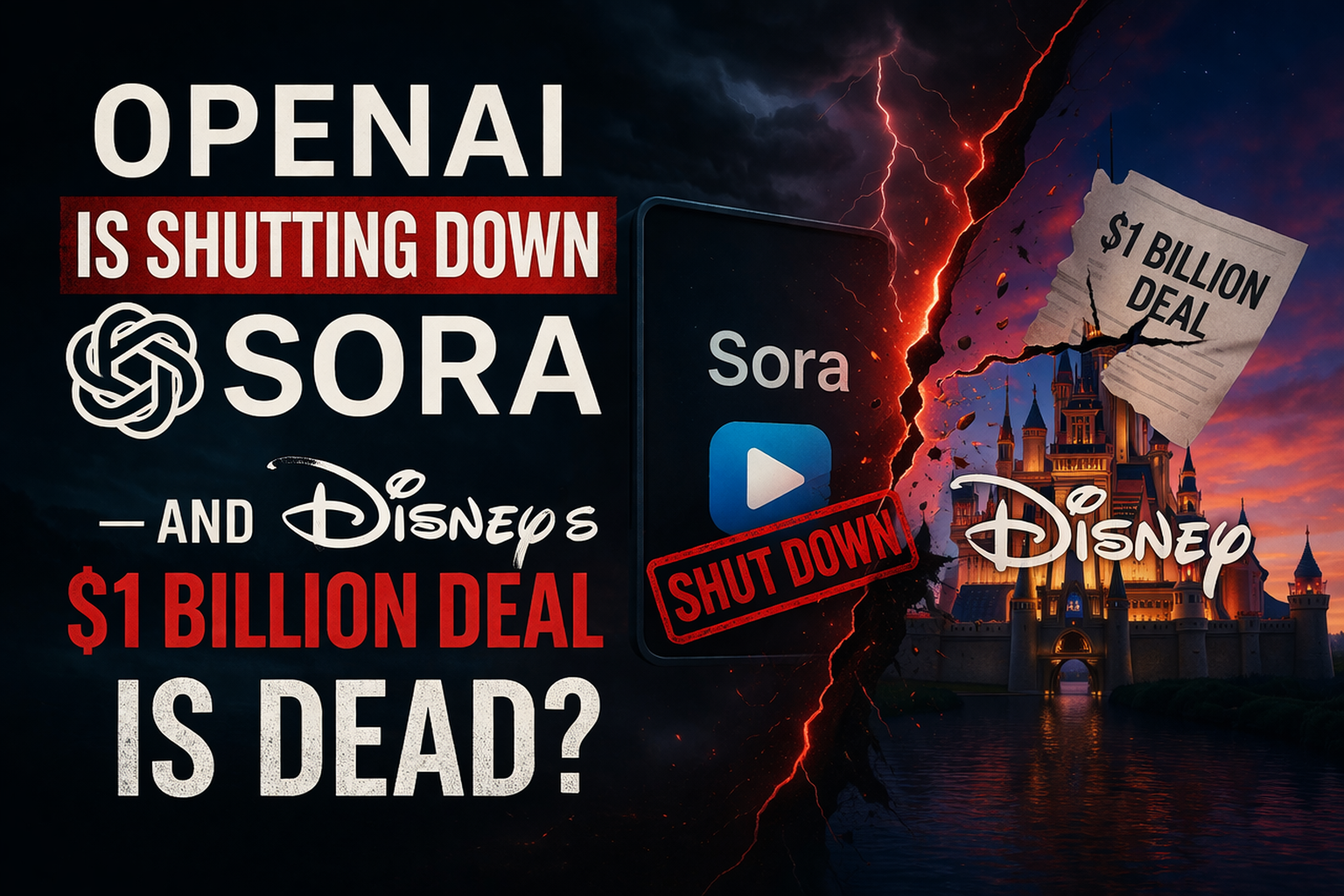
On March 24, 2026, OpenAI posted a brief message on X: “We’re saying goodbye to Sora.” No detailed explanation. No timeline. Just a confirmation that the company’s much-hyped AI video app — which hit the top of the App Store within days of its September 2025 launch — is being shut down. Alongside it, a $1 billion Disney partnership is dead before it ever really started.
What Happened
Sora launched in September 2025 as a standalone TikTok-style app built on OpenAI’s Sora 2 video generation model. It hit one million downloads in under five days and briefly dominated the App Store’s Photo and Video category. Users created viral clips, inserted themselves into film scenes, and generated content featuring copyrighted characters — which quickly became a liability.
By February 2026, downloads had dropped from a peak of over 3.3 million monthly to just over 1.1 million. Total lifetime in-app revenue came in at roughly $2.1 million — a negligible figure for a company operating at OpenAI’s scale and cost structure. The Sora team’s own head acknowledged in November 2025 that the platform’s GPU demand was so intense that their servers were effectively “melting,” forcing OpenAI to cap generations per user.
The Real Reason: Compute Costs and IPO Pressure
OpenAI is preparing for a potential IPO later in 2026 and has been auditing its spending accordingly. Sora was a high-compute, low-revenue consumer product competing in a market it wasn’t winning. Runway, Kling AI, and Pika had collectively captured the working creator market. Sora’s social feed format — designed to be a content platform, not a professional tool — failed to sustain user interest after the novelty wore off.
The official statement from OpenAI frames the shutdown as a refocus: “The Sora research team continues to focus on world simulation research to advance robotics that will help people solve real-world, physical tasks.” In other words, the underlying model work continues — but as infrastructure for robotics, not a consumer video product.
Disney Pulls the $1 Billion Investment
In December 2025, Disney announced a three-year licensing deal and a planned $1 billion investment in OpenAI, with Sora set to generate videos featuring characters from Disney, Marvel, Pixar, and Star Wars. It was one of the most high-profile AI-Hollywood partnerships ever announced. The transaction never closed. With Sora shutting down, Disney confirmed it is exiting the agreement: “We respect OpenAI’s decision to exit the video generation business and will continue to engage with AI platforms to find new ways to meet fans where they are.”
What Happens to Sora’s Users
OpenAI has said it is exploring ways to support export and preservation of user-created content from the app. No hard shutdown date has been announced yet — as of this writing, the web version of Sora remains accessible, but the API and app are being wound down. Video generation will also be removed from ChatGPT itself as part of the shutdown.
What This Means for the AI Video Market
Sora’s exit reshapes the competitive landscape in meaningful ways:
- Runway and Kling AI are the clearest beneficiaries — professional creators who were testing Sora now have two fewer reasons not to commit to those platforms
- Google’s Veo 3.1 is now the only major tech company with an active, well-resourced AI video model — and no major rights-holder conflicts yet
- The shutdown signals that standalone AI video apps may need a fundamentally different model than social feeds to sustain usage and justify compute costs
- Copyright risk is real — Sora’s IP controversies were a direct contributing factor in the decision to shut down rather than continue patching
Conclusion
Sora’s arc — from breakthrough demo to App Store hit to shutdown in under two years — is a useful lesson in the gap between impressive technology and sustainable product. The model was genuinely capable. The product around it wasn’t built for long-term retention. Browse our full AI video tools directory to explore the platforms that are filling the space Sora leaves behind.
